Sago Pondweed
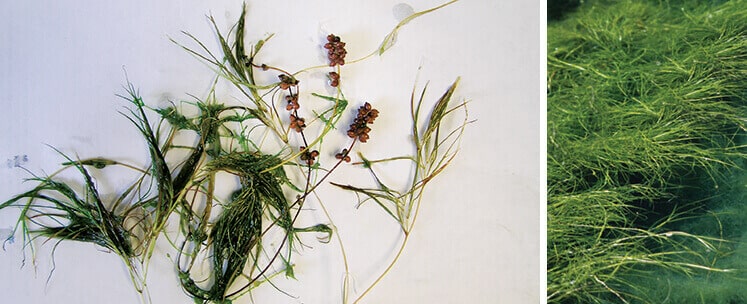
Description
Sago Pondweed is a perennial plant that arises from thickly matted rhizomes and has no floating leaves. The stems are thin, long and highly branching with leaves very thin and filament-like, about 1/16 of an inch wide and 2 to over 12 inches long tapering to a point. The leaves grow in thick layers and originate from a sheath. The fruit of Sago Pondweed is nut-like 1/8 to 1/4 inches long and 1/10 to 1/8 inches wide.
Mechanical Control
Sago Pondweed can be removed by cutting and raking from the pond. It will regrow from remaining roots and seeds.
Pond Dye can be used to limit sunlight into the pond. With reduced sunlight, photosynthesis cannot occur so growth will be stunted.
Chemical Control
There are several options to control Sago Pondweed. If you are not sure what treatment is right for your pond? Click here to view our product selection guide or choose from some of our most popular chemicals:
- Use a season long herbicide such as Airmax WipeOut or Sonar A.S.. One treatment treats Sago Pondweed and many other common pond weeds for the season.
- Use a broad spectrum contact herbicide, such as Ultra PondWeed Defense, will quickly kill Sago Pondweed. Because it does not stay in the water body, multiple treatments may be needed throughout the season.
- Use KnockDown Defense, a fast and selective herbicide that controls tough invasive and nuisance aquatic plants.
Chemical Application Best Practices
Anytime you use chemicals treat weeds and algae, please keep in mind the following:
- Treat your pond in sections. Treat only half the pond's surface at a time. During hot weather or when treating heavy growth, it is important to treat no more than 1/4 of your pond at a time and wait the full 14 days before re-applying. This helps lower the risk of fish loss during hot weather or when treating heavy growth.
- Once the weeds have browned & died, use a weed cutter & rake to remove as much dead material as possible. This prevents an accumulation of dead plant material and muck.
- Take a proactive approach to pond management. Use PondClear, MuckAway and Pond Dye to keep your pond looking great. For more information, see our article on the Airmax Ecosystem.
Ask an Expert
If you are unable to identify your pond weed(s) using our Weed ID Guide, follow this article to email us a photo.